
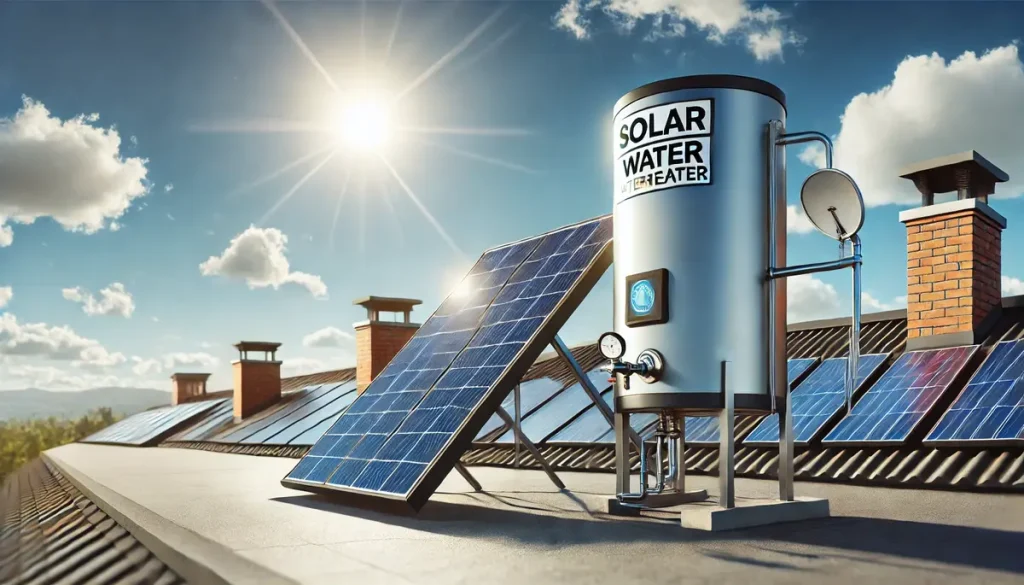
A solar water heater is a simple way to heat your water using the sun. It doesn’t rely on gas. It doesn’t depend on electricity either. Instead, it gathers energy from sunlight. Then it turns that energy into heat. That heat warms up your water. You can use it for showers, washing dishes, or doing laundry.
The system consists of several key components. First, there are solar panels or collectors. These soak up energy from the sun. Next, there’s a storage tank. This tank holds the hot water. Some setups also include a backup heater. That way, you still have hot water when the sun isn’t out.
There are two types of solar water heaters. Active systems use small pumps and controls. These help move water or heat around. Passive systems are simpler. They don’t need electricity. They rely on gravity and natural water flow.
These systems are most effective in sunny areas. However, some models are also designed for colder climates. Many people are now choosing solar water heaters. They want to save money on their energy bills. They also want to help the planet. Whether it’s for your home or your business, a solar water heater is a smart and sustainable choice.

How Do Solar Water Heaters Work?
Each part of the Solar Water Heater has a specific role. It collects the sun’s energy. It turns that energy into heat. Then it keeps your water warm until you need it. Here’s how the system works, step by step:
1. Collecting Sunlight
The process starts with solar collectors. These are flat panels or tube-shaped devices. They soak up the sun’s rays. You’ll often see them mounted on rooftops. They’re placed at an angle to catch the most sunlight during the day.
Flat-plate collectors look like dark glass panels. They trap heat under a clear cover. Evacuated tube collectors use long, glass tubes. These tubes hold in heat well. They work especially well in cold weather. If you live in a warm, sunny place, flat panels usually work best. However, if your winters are cold, tube-style collectors retain the heat more effectively.
2. Turning Sunlight into Hot Water
After the panels collect sunlight, that energy needs to heat your water. This happens in two main ways. Direct systems heat the water directly. Water flows through the panels and gets warm. These are best suited for areas where pipes are unlikely to freeze.
Indirect systems use a heat-transfer fluid. This could be antifreeze or another liquid. The fluid gets warm in the panel. It then passes through a heat exchanger. That exchanger warms the water. These systems are better for colder regions. Some setups also use small pumps. The pumps help move water or fluid smoothly. They make sure the heat transfers evenly.
3. Storing the Heat
Once heated, the water moves to a storage tank. These tanks are insulated. That means they hold the heat for hours. You can still use hot water later, even if the sun is gone.
The hot water flows through your standard plumbing. It reaches your taps, showers, and appliances. Some systems also come with backup heaters. These may run on gas or electricity. They help on cloudy days or when you need extra hot water.
So that’s how it all works. The system uses sunlight to give you hot water. It runs quietly in the background. It helps you save money. And it’s better for the environment too.
Read More: How Winter Maintenance Can Extend the Lifespan of Your Solar Panels
Top 7 Solar Water Heater Models
Sunbank 40‑Gallon Solar Water Heater
- Great for 1–3 People: The 40-gallon tank holds just enough hot water for a small household—no waste, no excess
- No Pumps, No Glycol—Low-Maintenance: It runs entirely on water line pressure (thermosiphon). That means no moving parts, which means fewer things can break—and installation is much simpler.
- Super-Insulated Stainless Steel Tank: This tank utilizes 316L stainless steel both inside and out for long-term corrosion protection, along with thick polyurethane insulation to maintain a warm water temperature for hours.
- Evacuated Tubes with High Efficiency: Sunbank utilizes 15 evacuated glass tubes featuring nickel-plated copper heat pipes that absorb nearly 92–96% of available sunlight, even on cloudy days.
- Backed by SRCC Certification: It’s SRCC certified, which means it’s eligible for federal solar tax credits through the end of 2025—and often local rebates too.
Perfect For
- Small homes (up to 3 users)
- People looking for DIY simplicity or minimal upkeep
- Off-grid systems powered by passive gravity flow
- Hot, sunny climates—or places with mild winters
- Those wanting tax incentives for renewable energy
Duda Solar 200 L Active Split System
- Fast and Reliable Heating: The evacuated tube collectors and high-efficiency heat pipes warm the water quickly—even on overcast days.
- Big Enough for Most Families: With 200 liters of storage, it’s well-suited for medium to larger households that use more hot water daily.
- Built for Cold Climates: It uses antifreeze-based fluids and meets OG‑100 SRCC certification—making sure you’re covered even in winter
- Tax-Friendly: Since it’s SRCC certified, it often qualifies for federal solar tax credits.
Perfect For…
- Families that need reliable hot water daily
- Homes in cooler regions or areas with variable weather
- People looking for an all-in-one solar water heating solution
Rheem Solar Loline 325 L Split System
- Perfect Size for Big Households: A 325L tank easily serves homes with 2 to 6 people, ensuring hot water is never a concern.
- Built for Reliability: Even when it’s cloudy, electric or gas boosters ensure there’s always hot water.
- Smart Freeze Protection: Advanced drain-back or antifreeze systems prevent pipe damage in cold weather.
- Energy-Saving Performance: Rheem claims up to 65–70% energy savings on water heating and less carbon footprint.
- Warranty: Comes with a guarantee of up to 10 years on the cylinder—a testament to their craftsmanship.
Perfect For…
- Larger homes with high hot water needs
- Installations where the tank stays on the ground, away from the roof weight
- Anyone wanting a solar system with backup heating options
- Residents in mild to moderate climates, with minimal frost risk
Heliatos Hybrid Solar Water Heater Kit
- Easy DIY Setup: The kit comes with everything you need. You connect it to your current water heater. No extra plumbing or tools required. No soldering even
- Grow-as-You-Go Design: Begin with a few panels and add more over time. It’s flexible, so you match your solar capacity to your needs.
- Saves Energy & Money: By relying on solar for a significant portion of your hot water needs, you use less gas or electricity.
Perfect For…
- Homeowners looking for an easy solar upgrade
- Those wanting to scale their system slowly
- Anyone needing a cost-effective solar boost without a complete replacement
SunHeater S601P Solar Heating System (SunHeater)
- Simple & Sturdy: Easy to install, lightweight, and long-lasting. Great for homeowners who want a no-fuss setup.
- Hotter Water, Lower Costs: Customers report that it can raise the pool water temperature by up to 10°F (6°C). Equivalent performance may work for basic hot water heating or support.
- Built to Last: Made of durable polypropylene, the panels resist corrosion and wear—even with heavy water exposure.
Perfect For
- Great for pool heating—and in some cases, supplemental hot water
- Ideal if you’re looking for an affordable, easy panel system
- Best suited to sunny regions with simple water heating needs
Solahart 302 L Solar Water Heater
- Streamlined Installation: No bulky tank on the ground—everything’s neatly mounted on your roof.
- Ceramic-Lined Tank: Built to resist corrosion and reduce maintenance, with a sacrificial anode for extra protection.
- Boost Climate Control: Comes with electric or gas booster options so you never run out of hot water.
- Energy Saving: Can cut your hot water energy use by up to 65%, especially compared to electric heaters.
Perfect for:
- Medium to large households with good sun exposure
- Homes wanting a stylish, space-saving rooftop system
- Homeowners who wish to reliable performance and access to government rebates
AO Smith Cirrex Solar Water Heating System
- Freeze-Resistant Fluid: Utilizes a mixture of propylene glycol and water that won’t freeze down to –30°F—a great choice in cold regions.
- Easy-to-Use Controls: Has a simple interface for setting water temperature and monitoring the system.
- Eco-Smart Design: Cuts energy usage and emissions by relying on solar levels—even in lower sun conditions.
- Built to Last: Corrosion-resistant tanks and collectors mean minimal upkeep and long-term durability.
Perfect for:
- Homes in colder areas need year-round solar hot water
- People who like smart controls and monitoring
- Anyone looking for a solar system that works effectively on both sunny and cloudy days.
Solar Water Heater Cost Breakdown and Savings in the U.S.
If you’re searching for solar water heater costs in the USA, here’s the simple truth: prices vary, but you really do save money especially if you live in a sunny state or you’re replacing an electric or propane heater.
Cost Breakdown of Components of Solar Heater Installation
Obviously, when you buy solar heaters, you don’t just have to pay for the panels. There are many additional charges that come with solar heaters installation. You have to pay for storage tanks. Pumps, pipes, controls, mounting hardware, labor and permits, too. Let’s see what’s the average cost breakdown of solar water heaters and where does your money go in the whole process.
- Solar panels/collectors: The panels take up the largest part of the budget. These usually make up about 30–45% of the total cost because they are the chief component of solar heaters and without them a solar heater won’t be called a solar heater as they capture the sunlight and turn it into heat.
- Storage tank and heat exchanger: The hot water tank and the part that transfers heat from the panels to the water usually make up around 15–25% of the cost. These are important because they store your hot water safely.
- Pumps, pipes, and controls: If your system uses pumps or special fluid then about 10–20% of the price go to them. They help move the hot water around your home.
- Mounting hardware: The brackets and materials used to attach the system to your roof are a smaller part of the cost and are usually about 5–10%.
- Labor and permits: This is the cost of paying professionals to install the system and getting the required city permits. In the U.S., acquiring a permit and paying installation fee costs about around 15–25% of the total price.
Average Solar Water Heater Cost in the U.S.
Most U.S. homeowners now pay about $3,000–$9,000 installed for a residential solar water heater, depending on size, system type, and how complex the roof/plumbing work is.
Passive solar water heater
A passive solar water heater is the most basic type. It has no pump or motor. The water moves by itself using gravity and natural flow.
Because it’s simple, it’s usually the cheapest choice. Moreover, it is the best option for warm or mild climates where pipes don’t freeze often.
In the U.S., for a passive solar water heater system you need to spend about $3,000 to $5,000 for everything from buying the system to getting it fully installed and ready to use in your home.
Active solar water heater
An active solar water heater uses small pumps and a controller to move water or a special heat-transfer fluid through the panels and into the tank. This makes it more powerful and more reliable in colder states,
Due to heat-transfer fluid, the system can protect itself from freezing therefore it is suitable for states where temperature falls to freezing point in winters.
Due to pumps, controllers, and heat-transfer fluid, active solar heaters are a bit pricier than passive ones. It usually costs between $4,000–$8,000 installed, depending on size and design.
Large split or premium systems
The premium system is the most advanced heater out of these three types of heater we mentioned. Their tanks are usually present on the ground while collectors are fitted on the roofs. These solar heaters use evacuated tubes and stronger freeze protection to deal with temperature beyond freezing points. So it’s best for the states like Alaska where it’s freezing cold in winters.
As they are bigger and more advanced therefore they are more costly. Their complete installation cost about $8,000–$13,000 before incentives.
How much can a U.S. homeowner save each year?
A solar water heater is a big save for U.S. home owners. According to the U.S. Department of Energy, these heaters reduce water heating costs to around 50-80%.
Most U.S. families who switch to a solar water heater save about $200–$600 every year on their gas or electric bills. If you are a homeowner and have switched to solar heaters from propane or expensive electricity heaters, you will be saving even more money.
When does a solar water heater “pay for itself”?
A solar water heater begins to pay you back through the money you save on your hot-water bills. Most homeowners get their full money back in about 4–8 years when they use available rebates and tax credits.
Right now, many U.S. homeowners can still get about 30% off the total cost through the Residential Clean Energy Credit. Some states and electric companies also give extra rebates, which lower the price even more.
Because of these discounts, many families see their solar water heater pay for itself in about 4–8 years, depending on:
- how much they paid after incentives
- how high their local energy prices are
- how much hot water they use daily
If someone cannot use tax credits or rebates, they still save money each year but they must pay the full cost of the system upfront.
Without incentives, a homeowner may need 8–12 years or more to fully get their money back, especially in areas where natural gas is very cheap.
Why Costs Change by State (California vs Texas vs Florida vs Northeast)
The main factors behind the variation in costs are
- Labor rates and permits
- Roof type and complexity
- Climate (mild vs freezing)
- State / utility rebates
- Location
Location is a key factor, and that southern U.S. homeowners often pay less, sometimes up to $1,000 less for collectors because of higher solar potential and simpler installs.
California
In California, cost is mostly high, especially toward the upper range ($6,000–$10,000) because of higher labor, strict codes, and many roof-mounted systems. Many areas offer rebates, discounts, or payments for using solar hot water. These rebates include CSI-style programs, local rebates, and performance-based payments. So, despite having high cost, incentives make the adoption of solar water heaters bearable and lower your total cost altogether.
Texas
In Texas, the cost to install a solar water heater is often in the middle range because workers charge less and permits are easier to get. But Texas doesn’t have one big statewide rebate, but some electric companies like Austin Energy and CPS Energy do give small rebates or discounts for solar systems, including solar hot water in some areas.
Florida
In Florida, prices are usually fair and competitive because many companies install solar systems, roofs are easy to work on, and the state gets lots of sunshine.
Moreover, Florida gives many benefits to homeowners who install solar systems. There is no sales tax on solar equipment and no increase in property taxes for adding solar to your home.
Because Florida is the “Sunshine State” and people use hot water all year, homeowners can get strong savings even with a medium-sized solar water heater.
New York & Massachusetts (Northeast)
In New York and Massachusetts, solar water heaters usually cost more. This is because the winters are very cold, so the systems need special antifreeze parts to stop pipes from freezing. Also, installation takes more work, and labor costs are higher.
But, to ease the high cost both states offer strong rebates and tax credits through programs like NYSERDA (New York) and MassCEC (Massachusetts) to lower the final price.
FAQs about Solar Water Heater
1. What is a solar water heater?
It’s a way to heat your water using sunlight—no gas, no significant power bills. Sunlight hits special panels (like flat plates or glass tubes), and that heat warms your water in a storage tank. Some systems use pumps, while others rely solely on gravity. Most even come with a backup for cloudy days.
2. Which one’s best for a small home or off-grid life?
The Sunbank 40-Gallon model is perfect. It doesn’t need pumps or power—just sunlight and water pressure. It’s quiet, super insulated, and keeps water hot for hours. Bonus: It also qualifies for tax credits.
3. Can solar heaters work in cold places?
Absolutely. The Duda 200L and AO Smith Cirrex models are made for frosty weather. They use special fluids that don’t freeze and still keep your water warm—even when it’s freezing outside.
4. Can I install it myself?
If you’re handy, the Heliatos Hybrid Kit is a DIY-friendly option. No soldering, no fancy tools. You just connect it to your existing water heater. Want something bigger or roof-mounted? Best to call a pro.
5. What’s the cheapest way to start saving?
Try the SunHeater S601P. It’s super affordable, easy to install, and great for boosting your hot water supply. It’s designed for pool heating, but it also works well in sunny spots for basic water warming.