
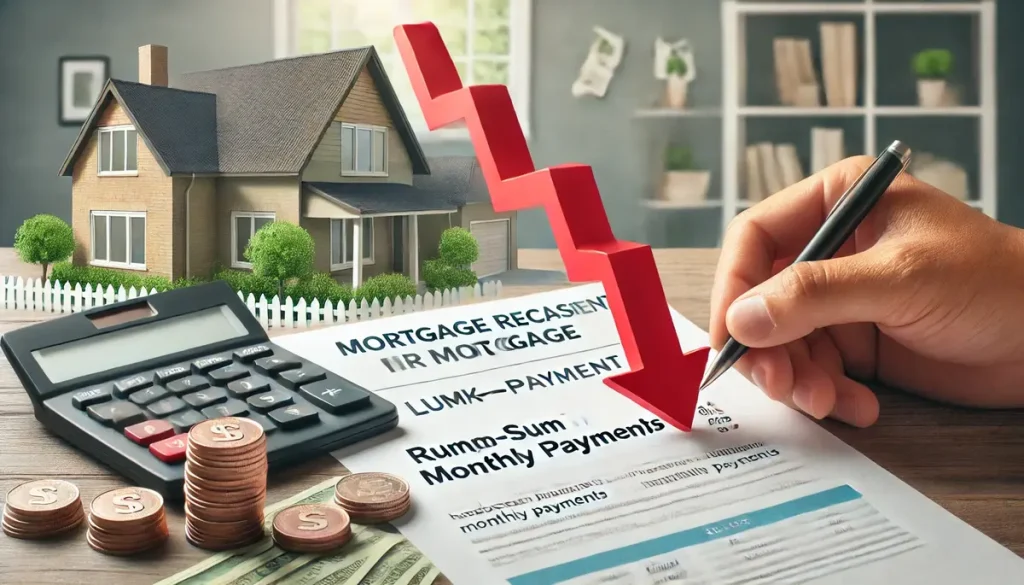
What if you could lower your mortgage payment without getting a brand-new loan? Mortgage recasting makes that possible. You make one lump-sum payment, and your monthly bill goes down.
In this blog, we’ll explain what mortgage recasting is, how it works, and how to calculate it!

What Is Mortgage Recasting?
Mortgage recasting is a way to lower your monthly mortgage payments. You do not need to refinance to do this.
You make a large, one-time payment toward your loan’s principal. After this payment, the lender recalculates your loan. This step is called “reamortizing.” The new calculation is based on the smaller balance. Your interest rate does not change. Your loan term also stays the same.
You are not paying off the loan early. You are only lowering the balance used to calculate your payments. A smaller balance means smaller monthly payments. This continues for the rest of your loan. Over time, you can save a lot of money.
Not all mortgages qualify for a recast. FHA loans do not allow it. VA and USDA loans usually do not allow it either. Even if your loan qualifies, lenders often have rules. They may require a minimum lump-sum payment. They may also require that your payments are already up to date.
Read More: Second Home Mortgage Rates in 2024: What You Need to Know
How Does Mortgage Recasting Work?
Mortgage recasting is a simple process. It can lower your monthly payments. It keeps your interest rate the same. It also keeps your loan term the same.
1. Make a Lump-Sum Payment Toward Your Principal
The first step is to make a large payment toward your loan’s principal balance. This reduces the amount you owe. It also updates your loan’s amortization schedule.
Most lenders require a big payment for a recast. Small payments usually do not qualify.
For example, you may owe $200,000 on your mortgage. If you pay $50,000 in a lump sum, your balance drops to $150,000. The lower balance means your monthly payments are recalculated. They will be smaller for the rest of the loan term.
Things to keep in mind:
- Your payment must meet your lender’s minimum requirement. This amount is different for each lender.
- Do not use money you need for essential expenses or savings.
- Make sure this payment will not cause financial problems later.
2. Lender Recalculates and Reamortizes the Loan
Your lender gets your lump-sum payment. They then update your loan schedule. This process is called reamortization.
In simple terms, your lender spreads your remaining payments over the same loan term. The balance is now smaller.
Your interest rate stays the same. Your loan term also stays the same. The only change is the size of your monthly payment. This is because the schedule is based on a smaller principal amount.
What happens during reamortization:
- The lump-sum payment goes toward your principal balance.
- The lender recalculates the remaining payments based on the new balance.
- The interest rate stays the same.
3. Lower Monthly Payments
The main benefit of mortgage recasting is lower monthly payments. You now owe less. The lender spreads payments over a smaller amount. This makes your monthly cost lower for the rest of your loan term.
For example, your mortgage payment might be $1,074. After a $50,000 lump-sum payment, it could drop to about $800. The exact amount depends on your loan term and interest rate.
Lower payments give you more breathing room in your budget.
Why lower payments help:
- Less pressure on your monthly finances.
- More money for savings or investments.
- You keep the same interest rate but pay less each month.
4. Recasting Doesn’t Change Your Loan Term or Interest Rate
Recasting is not the same as refinancing. Refinancing can give you a lower interest rate. It can also shorten your loan term.
Recasting only lowers your payments by reducing your principal. It does not change your interest rate or term.
If you had 20 years left before the recast, you will still have 20 years after it. Your interest rate will be the same.
Key differences to note:
- Recasting lowers payments but keeps your loan term the same.
- It does not give you a new interest rate.
- It does not shorten your repayment period.
Mortgage Recasting vs. Refinancing
Mortgage recasting and refinancing might sound like the same thing. But they work in very different ways.
Refinancing means replacing your current mortgage with a brand-new loan. This can help you get a lower interest rate. It can also let you shorten your loan term. Think of it as starting over with a fresh loan agreement.
Recasting works differently. You keep your current loan just as it is. The interest rate doesn’t change. The loan term also stays the same. The only thing that changes is your monthly payment. After you make a lump-sum payment, your lender recalculates the payments based on the smaller loan balance.
Here’s a quick breakdown:
- Interest rate: Refinancing can give you a new, lower rate. Recasting keeps your current rate.
- Costs: Refinancing often comes with closing costs. Recasting usually only has a small fee.
- Loan term: Refinancing can change the length of your loan. For example, you could go from 30 years to 15 years. Recasting keeps the same term.
If you’re happy with your current rate and just want smaller monthly payments, recasting might be your best choice. But if you want a lower rate or a shorter payoff period, refinancing may be the better option.
Mortgage Recasting vs. Making Extra Principal Payments
Many people mix up recasting with simply paying extra toward the principal. Both involve putting more money toward your mortgage. But the results are different.
With a recast: You make a lump-sum payment toward your loan. The lender then recalculates your monthly payment based on the new, smaller balance. This means you’ll pay less each month going forward.
With extra principal payments: You still reduce your loan balance, but your monthly payment stays the same. Instead, your loan gets paid off faster.
The main perk of a recast is instant relief—you see smaller monthly bills right away. The perk of extra payments is long-term—you become debt-free sooner.
If you’ve come into a large sum of money and want lower payments now, a recast can give you that breathing room. But if you’re okay with your current payment and want to finish your loan faster, extra principal payments might be the better move.
How to Calculate Your Mortgage Recast
Before you choose a mortgage recast, check your numbers. See how much your monthly payment could drop. Check if the savings match your financial goals.
A recast works when you make a large one-time payment toward your principal. Your lender recalculates your payment using the smaller balance.
1. Find Your Current Loan Balance
Check how much you owe on your mortgage. Look at your latest mortgage statement. If you are unsure, call your lender. Ask for the exact amount.
The lump sum will be subtracted from this balance. The new balance will be used to set your payment.
Example: You owe $200,000. You pay $50,000. Your new balance will be $150,000.
2. Choose Your Lump Sum
Decide how much you can pay now. A larger payment lowers your monthly bill more.
Some lenders have a minimum lump-sum requirement. Ask your lender about it. Keep enough savings for other needs.
3. Estimate Your New Payment
Pay the lump sum first. Then your lender will recalculate the loan. The interest rate stays the same. The loan term stays the same. Only the monthly payment changes.
Example:
- Balance before: $200,000
- Lump sum: $50,000
- Balance after: $150,000
- Payment drops from $1,074 to about $800.
4. Try an Online Calculator
Use an amortization calculator to see your new payment. Enter your loan balance. Enter your interest rate. Enter your loan term. Add the lump sum. Check the new payment amount. Compare it to your current payment. This will help you see if a recast is worth it.
FAQs About Mortgage Recasting
What exactly is mortgage recasting, and how does it work?
Mortgage recasting is a way to lower your monthly mortgage payments. You do not replace your loan. You make one large payment toward your principal. Your lender recalculates your payment using the new, smaller balance. Your interest rate stays the same. Your loan term also stays the same. Your monthly bill drops for the rest of your loan.
How is mortgage recasting different from refinancing?
Refinancing gives you a whole new loan. This can change your interest rate. It can also change your loan term. It usually comes with closing costs. Mortgage recasting keeps your current loan exactly as it is. You pay a lump sum. Your lender adjusts your monthly payment to reflect the smaller balance. It is faster. It is simpler. It usually costs much less than refinancing.
Does every mortgage qualify for recasting?
Not all mortgages allow recasting. FHA loans do not qualify. VA loans do not qualify. USDA loans also do not qualify. Even if your loan type allows it, your lender might have rules. They may require a minimum lump-sum payment. They may require that your account is up to date. Always check with your lender before you make plans.
How much money should I put toward a mortgage recast?
That depends on your budget. It also depends on your financial goals. The more you pay now, the more your monthly payment will drop. Some lenders set a minimum lump-sum requirement. Ask about their rules first. Do not use money you will need for emergencies. Do not use money needed for bills or other savings goals.
5. Is recasting better than just making extra principal payments?
It depends on your goal. With a recast, your payment drops right away. This gives you breathing room in your budget. With extra payments, your monthly payment stays the same. But you will pay off your loan faster. If you want to lower your monthly expenses, recasting makes sense. If you want to finish your mortgage sooner, extra payments might be the better choice.