
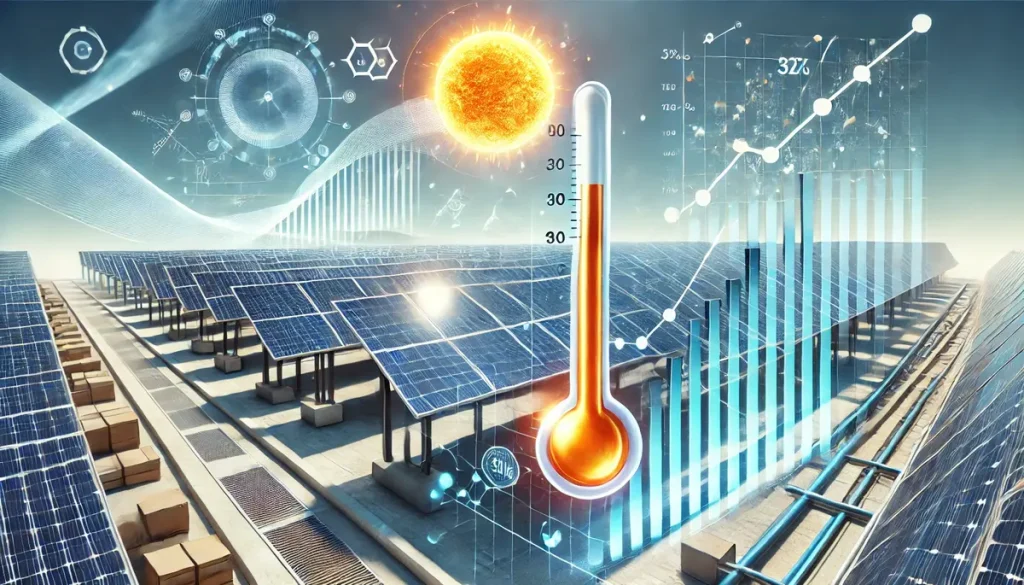
More sun does not always mean more power. Too much heat can lower panel performance. That is why temperature coefficients matter. They show how heat changes solar panel performance. By understanding them, homeowners can improve solar efficiency. Businesses can also get more from their systems.
What Are Temperature Coefficients?
A temperature coefficient in solar panels is like a scorecard that shows how panels react when the heat rises.
In simple words, it tells you how much power a panel will lose. The loss is measured for every degree Celsius above the standard test temperature. That standard is usually 25°C.
Temperature coefficients are measured in percent per degree Celsius (%/°C). A smaller number is better. It means the panel loses less power in the heat.
There are three main types:
- Voltage Coefficient (Voc): This shows how much the voltage drops when the panel gets hotter.
- Current Coefficient (Isc): This shows how less the current rises as the temperature goes up.
- Power Coefficient (Pmax): This is the most important one. It shows how the panel’s maximum power changes with heat.
This matters because solar panels remain in the sun all day. Poor temperature coefficients mean the panel can lose a lot of efficiency in hot weather. Panels with better ratings give more reliable performance. They also save you more energy in the reality.
How Temperature Affects Solar Panel Performance
When solar panels get hotter, their efficiency goes down. It might sound odd. We often think more sun should always mean more power. But heat and sunlight are not the same. Panels need sunlight. They don’t want heat.
Every panel has a temperature coefficient that shows how much efficiency it loses as the temperature rises.
For example, a panel with a rating of -0.4% per °C will lose about 4% efficiency when the temperature is 10°C above the test level. That test level is called Standard Test Conditions (STC). It is set at 25°C.
In cooler or mild climates, panels stay closer to that temperature. The loss is smaller. Performance stays more stable. In hotter regions, the difference is bigger. A panel working at 40°C or 45°C will lose more output because of the heat.
This is why the idea that “more sun always means more power” is wrong. A very hot summer day might produce less power than a cooler spring day with the same sunlight. What matters is balance. Strong sunlight with moderate temperatures gives the best results.
For homeowners, this is a key lesson. Always check the temperature coefficients before buying panels. Better ratings mean panels perform well in the heat. That gives you more reliable power and bigger savings in the long run.
Read More: Boost Solar Savings with Solar Batteries without Backup
Key Benefits of Understanding Temperature Coefficients
Knowing about temperature coefficients is not just technical talk. It has real value. Homeowners and businesses can use it to get more reliable solar energy. Here are the main benefits.
Smarter Solar Panel Selection
The temperature coefficient is a key detail when comparing panels. It shows how much performance the panel will lose as the temperature goes up. Panels with a lower coefficient are better for hot climates. They lose less power on very hot days.
Two panels may have the same wattage rating on paper. But in real conditions, they can perform very differently. Checking the coefficient helps homeowners make smarter choices. It also helps them avoid disappointment later.
Improved Energy Yield Predictions
Panels are tested in labs under Standard Test Conditions (STC). But your roof is not a lab. Real temperatures often go higher. This reduces the output.
Knowing the coefficient helps you estimate the actual yearly energy yield. Your predictions become more accurate. It also gives you a clearer picture of your return on investment (ROI). Instead of guessing, you can see how much power your system will deliver in your climate.
Better System Design & Placement
Temperature coefficients guide system design too. Heat builds up more when panels are close together or installed without airflow. If you know how sensitive your panels are, you can design better.
For example, rooftop panels may get hotter because air circulation is limited. Ground-mounted systems often stay cooler because of better airflow. Even small changes in orientation and spacing can cut down heat buildup. That improves performance.
Financial & Environmental Gains
Better temperature performance means fewer energy losses. Fewer losses mean higher savings on electricity bills over time. There is also an environmental benefit. Efficient panels create more clean energy. That reduces the need for fossil fuels.
For homes and businesses, this supports sustainability goals. In the long run, knowing about coefficients helps both your wallet and the planet.
Different Types of Solar Panels & Their Temperature Coefficients
Not all solar panels react to heat the same way. The temperature coefficient depends on the type of panel. Knowing this helps you choose the right one.
Monocrystalline Panels
These are the most common panels on rooftops. They are very efficient. They make a lot of power in small spaces. Their coefficients are moderate. They lose some power in heat, but not too much. The usual range is -0.3% to -0.4% per °C.
Polycrystalline Panels
These panels are cheaper. But they are less efficient. Their coefficients are higher than monocrystalline. They lose power faster as heat rises. Most fall around -0.4% to -0.5% per °C. In hot areas, this loss is easy to see.
Thin-Film Panels
Thin-film panels work differently. They are less efficient per square foot. But they handle heat better. Their coefficients are very low, about -0.2% to -0.25% per °C. This makes them great for hot regions. They also work well for ground projects where space is plenty.
Factors Influencing the Solar Panel Temperature Coefficient
Many factors affect the temperature coefficient of solar panels. Let’s look at the main ones.
Panel Technology and Design
The technology and design of solar panels affect their temperature coefficient. The structure and layout also play a role. Different panel types have different coefficients. Monocrystalline and polycrystalline silicon panels usually range from -0.44% to -0.50% per °C.
Maxeon monocrystalline panels perform better. They have a coefficient of -0.38% per °C. This makes them one of the best choices. Thin-film solar panels do even better in heat. They often have coefficients around -0.2% per °C. That is much lower than traditional silicon panels.
Roofing Material
Your roofing material affects panel temperature. Some roofs absorb heat more, while others reflect it.
Here are common options:
- Asphalt shingles – absorb less sunlight.
- Metal – reflects sunlight well.
- Tile, tar, and gravel – moderate options.
- Wood (synthetic cedar) – works well for ground-mounted systems or solar farms.
In general, lighter roofs are better. They reflect more sunlight and keep the roof cooler. This prevents your panels from overheating. They act as shade and keep the roof cooler. This is a big benefit in hot regions.
Location
Your location has a major impact. Climate and average temperature are the main factors. Hot and humid places, like Texas or Florida, have high daily temperatures. Roofs and panel areas in these places often get too hot. If you live in such regions, take steps to keep panels cool. Your roofing material matters. But other factors also help, like shading, airflow, and orientation.
Two key location elements affect the coefficient most:
- The climate in your area.
- The average temperature where the panels are installed.
How to Mitigate Temperature Losses
Solar panels always face some heat loss. But you can reduce the impact. Simple design and setup choices help panels stay cooler. Cooler panels work better and last longer.
Proper Installation
Airflow is very important. A small air gap between the panel and the roof lets hot air escape. This keeps the panels cooler. Some systems also add cooling designs to cut down heat buildup.
Reflective Roofing Materials
The roof plays a big role. Dark roofs hold heat. This heat warms the panels even more. Reflective or light-colored roofs reflect the sun. This lowers the heat. Both the roof and the panels stay cooler.
Smart Inverters and Monitoring
Modern inverters adjust panel performance during hot hours. Monitoring tools show when efficiency drops. This helps homeowners notice problems quickly. It also keeps the system running smoothly.
Hybrid Systems with Storage
Battery storage is another smart option. Panels often lose output during midday heat. A hybrid system stores extra power from cooler times of the day. That energy can be used later. It keeps your supply steady. Using these methods reduces heat loss. Panels give more energy. You save more money. And your panels last longer.
FAQs about the Impact of Temperature Coefficients on Solar Panel Performance
1. What is a good temperature coefficient for solar panels?
A good temperature coefficient is about -0.3% to -0.4% per °C. The closer it is to zero, the better. A small number means less power loss in heat.
2. How much efficiency do panels lose in hot climates?
Panels lose 0.3% to 0.5% per °C above 25°C. At 35°C, this is about 3–5% power loss. The exact number depends on the panel type.
3. Do cold temperatures improve solar panel performance?
Yes. Cold air makes panels work better. Panels give the best results with strong sunlight and cool air. Clear, cold days can give very high output.
4. Which type of solar panel has the lowest temperature coefficient?
Thin-film panels have the lowest numbers, about -0.2% to -0.25% per °C. They work best in hot regions. Monocrystalline and polycrystalline lose more power.
5. Can installation methods reduce temperature-related losses?
Yes. Small air gaps help airflow. Light roofs reflect heat. Good spacing also keeps panels cooler. All these steps reduce heat loss.